
Sibilance
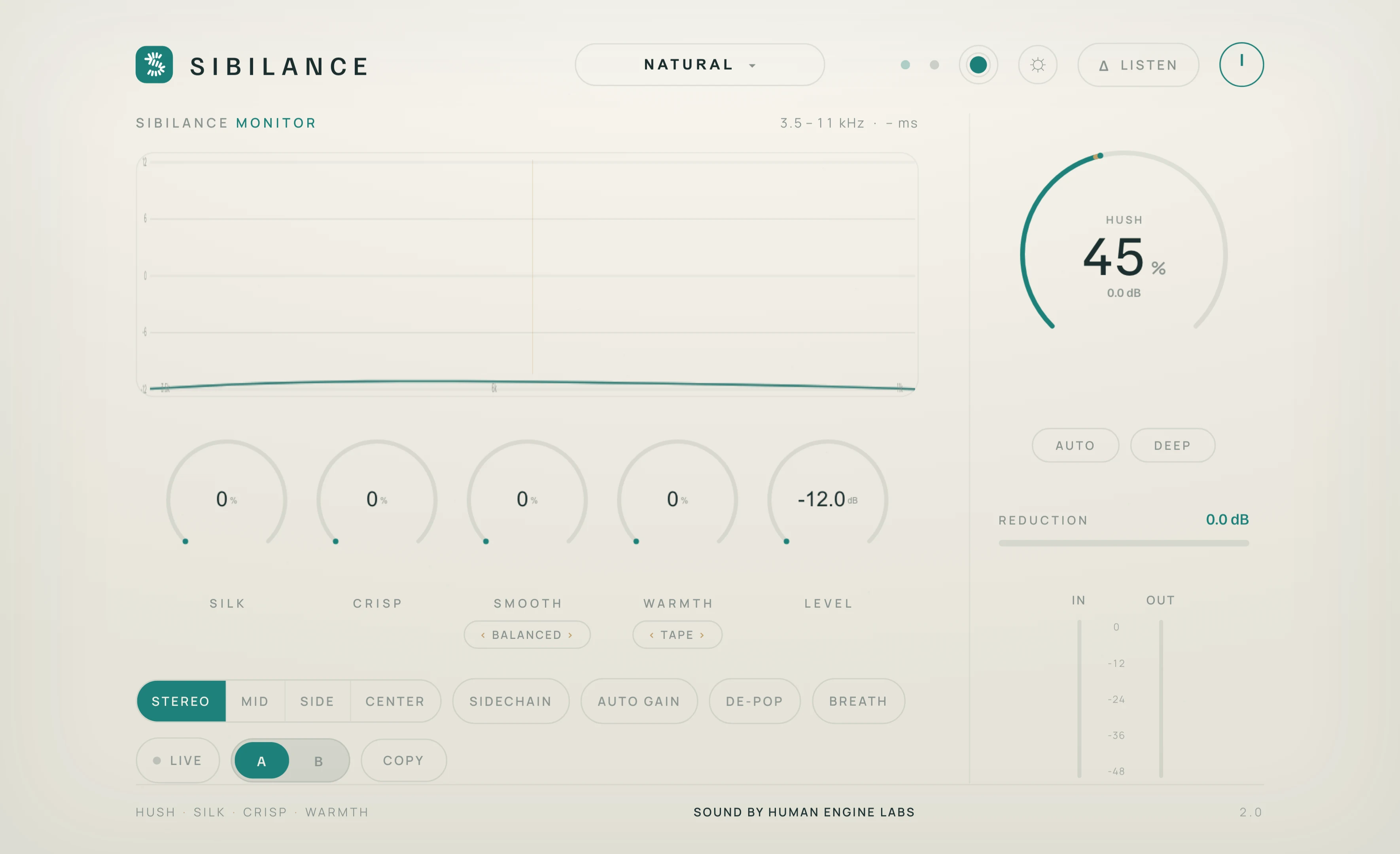
Built & validatedA de-esser for vocals that are already close, except for the sharp consonants. Sibilance reduces the harsh ess without pulling down the whole top end, so the vocal stays bright, intelligible, and where you mixed it.
Demo · Hear it
A harsh vocal, tamed.
A deliberately harsh, bright-mic take: the kind of piercing sibilance a de-esser exists for. Flip between the three while it plays. The esses come right down, the body of the voice does not move, and the third button solos exactly what the engine took: ess, and nothing but ess.
“Wouldn’t you like to sit down and rest? There is a seat in the garden at the side of the house.”



A deliberately harsh, bright-mic vocal, de-essed hard through the shipping engine. De-essing only, at Hush 82, loudness-matched. Switch to Removed and the sustained vowels drop out; only the sibilant bursts remain, inside the marked 4 to 11 kHz band. Source: LibriTTS (CC BY 4.0).
Validation
Every claim is a number.
The headline figures come straight out of the shipping build's suite. These are the numbers, reported as they are measured, and each one is gated in CI so it cannot silently regress.
Amount-response de-ess deepens monotonically with Hush at the harsh core; at 7 kHz it intentionally eases at max Hush as the depth-linked de-lisp restores 's' definition.
Each flavour keeps its signature with a natural roll-off toward the low-mids, and the drive is gated so it can't drift back to harshness. Full harmonic measurements are on the validation page.
Phoneme-aware detection
Three dissimilar lanes.
The de-ess decision runs through three dissimilar lanes, the command-and-monitor pattern from flight-control computers. Detection stays fast and deterministic, the classifier only ever protects, and no single lane fault can force a wrong cut.
Fused HF-dominance × spectral-flatness × (1−voicing) on a rate-invariant FFT. Fast, never hallucinates, and gets no vote on what a sound is.
A sequence TDNN that tells s / sh / f-th / t / vowel apart. It vetoes de-essing only for a recognised plosive or fricative worth keeping.
It requires the veto to persist across windows, so one confidently-wrong frame can't trip protection or flash a false letter.
Real-speech classifier accuracy on 80 fully-unseen LibriTTS utterances, 82.8% overall: s 97%, sh 93%, vowel 84%, f-th 76%, t 57%, reported honestly (plosives generalise the hardest).
Plosive protection is not the classifier's job alone: the deterministic COMMAND lane catches broadband transients and the temporal CONTROL lane requires persistence, so effective consonant protection exceeds any single number. Detection is level-independent, auto-calibrating to each voice's brightness, so it works the same on a whisper or a belt.
The de-essing engine
Only the band that is the problem moves.
The signal splits into low body, an 8-band sibilant region, and air. Only the sibilant bands can move. Below and above, the voice is untouchable. The two curves are identical everywhere except the one region that needed help.
Hush
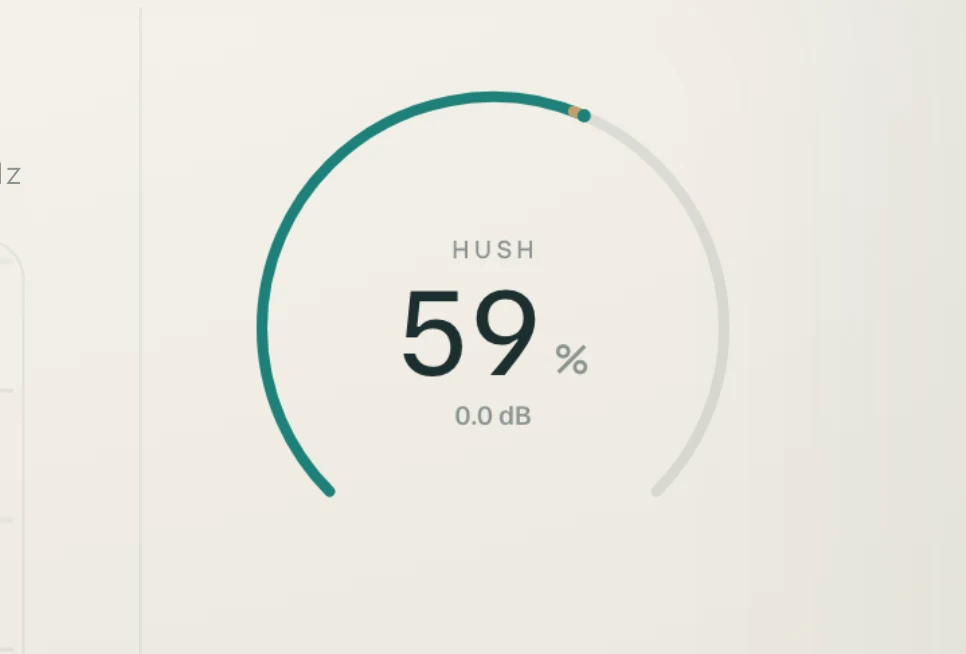
One dial does the job.
Turn it up to remove more. The number is the amount, and the reading below it is live gain reduction in dB. Because detection is level-independent and calibrated per voice, this is usually the only control you touch.
Not sure where to start? Play a few seconds and tap Auto. The Tracking Assistant listens to how prevalent the sibilance actually is and sets a recommended starting point. Nudge from there.
The single authority
One decision, made once, and committed. The voice stays exactly where you put it.
Finishing tools
More than a de-esser.
After the one decision, a set of finishing tools that each stay in their lane: air above the ess band, colour confined to the body, cleanup, plosive and breath control, and honest loudness. None of them can undo the de-essing.
Air
A gentle high-shelf that opens the top without re-harshening the de-essed band.
Analog colour
Transformer 12% THD balanced 2nd+3rd, Tube 17.5% 2nd-dominant triode, Tape 8.2% soft magnetic. Body-only, gain-matched, DC-blocked, an exact null at 0.
Resonance + denoise
A 24-band resonance tamer plus a decision-directed denoiser. Balanced, Resonance-only, or Denoise-only.
Plosive control
Catches brief sub-120 Hz 'p' and 'b' bursts and high-passes only when one is detected.
Breath control
Gently ducks breaths between phrases, leaving the words untouched.
Honest loudness
Matches output loudness to input within 0.29 LU, so an A/B is the processing, not the level.
Silk · Crisp · Smooth · Warmth · Level
The finish, after the decision.
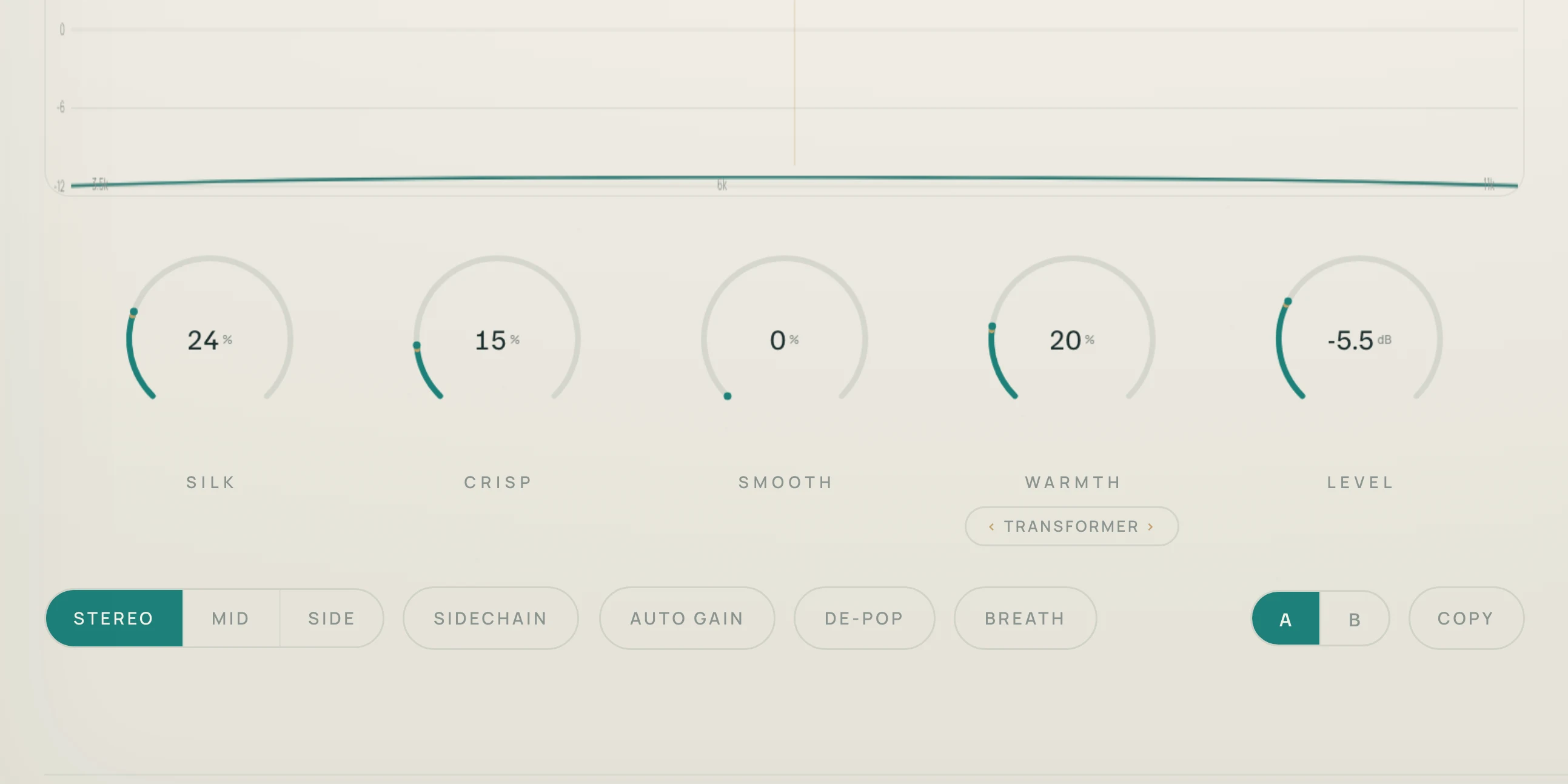
Silk lifts an airy shelf above the ess band, applied after de-essing, so it can never re-harshen what you just tamed. Crisp gives back the top of the 's', and gives back more the harder you de-ess.
Warmth is gain-matched saturation confined to the body, so the highs pass through clean. Smooth is a separate 24-band cleanup with a decision-directed denoiser. Level trims the output.
Control & workflow
Built for where it has to work.
Stereo placement, two latency profiles, honest A/B, external sidechain, 16 validated presets, and a resizable, accessible UI. Under all of it, the same fault tolerance: bad input fails safe and gets counted.
- Stereo modes
- Stereo · Mid · Side · Center. The Spatial Stabilizer pulls sibilance back to centre and keeps the width.
- Live / Studio
- Studio adds 5 ms look-ahead for maximum precision. Live runs ~1 ms for near-zero-latency tracking at the same accuracy.
- Δ Listen
- Solo exactly what is being removed. Hold to audition.
- A / B + Copy
- Two full-state slots, honest loudness-matched compare.
- External sidechain
- Drive detection from another source.
- 21 factory presets
- Vocal · Spoken Word · Repair · Character · Master. Each one gated to de-ess AND to preserve the voice.
- UI
- Resizable 0.8–2.0×, 5 skins × light/dark, a real-time phoneme monitor, screen-reader accessible.
- Fault tolerance
- Non-finite host input is flushed to zero and counted. A 200 ms NaN storm produces zero non-finite output, and de-essing self-heals.
The UI
Five skins, one instrument.
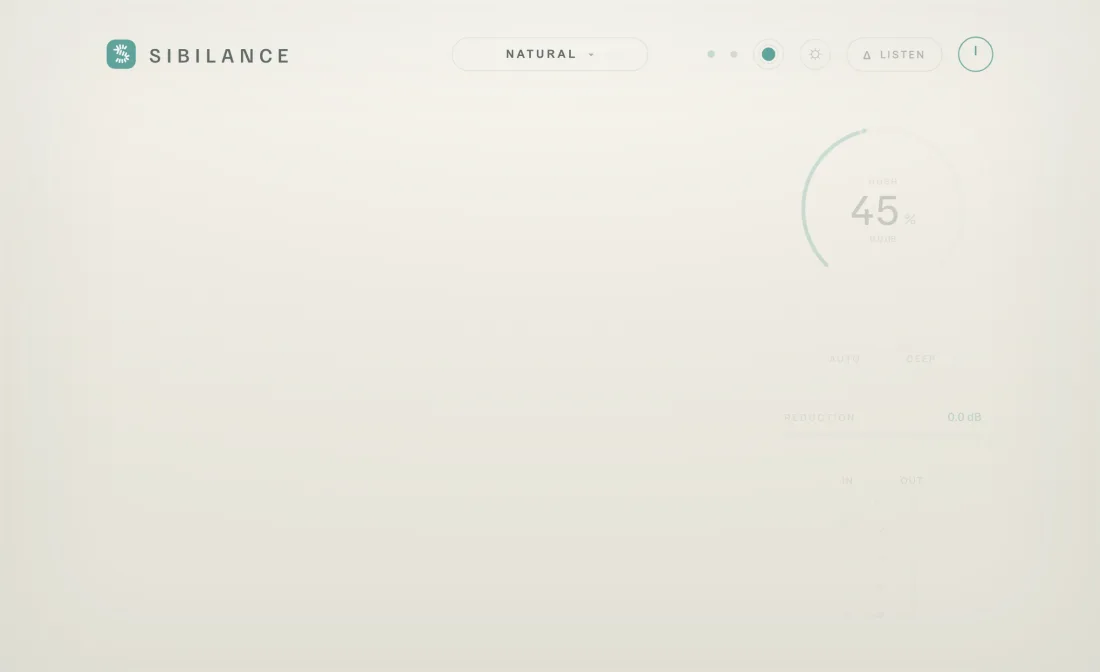
Each skin is a full accent-and-atmosphere palette that ships in both light and dark, switchable live from the swatch in the header and remembered across sessions, exactly like the theme toggle. Studio Teal stays the default; the geometry never changes, only the colour. Every image below is rendered from the actual plugin UI.
Studio Teal
DefaultThe default. Cool teal over warm ivory, the look you already have.
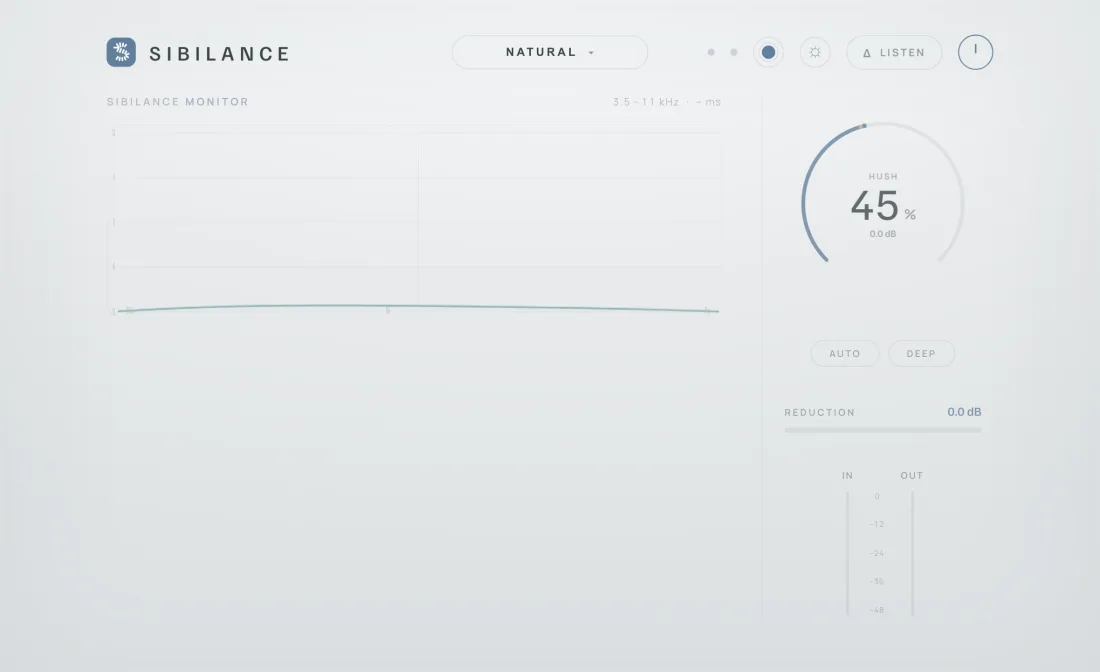
Graphite
Neutral steel. A blue-grey accent over cool grounds, the understated pro-tool look.
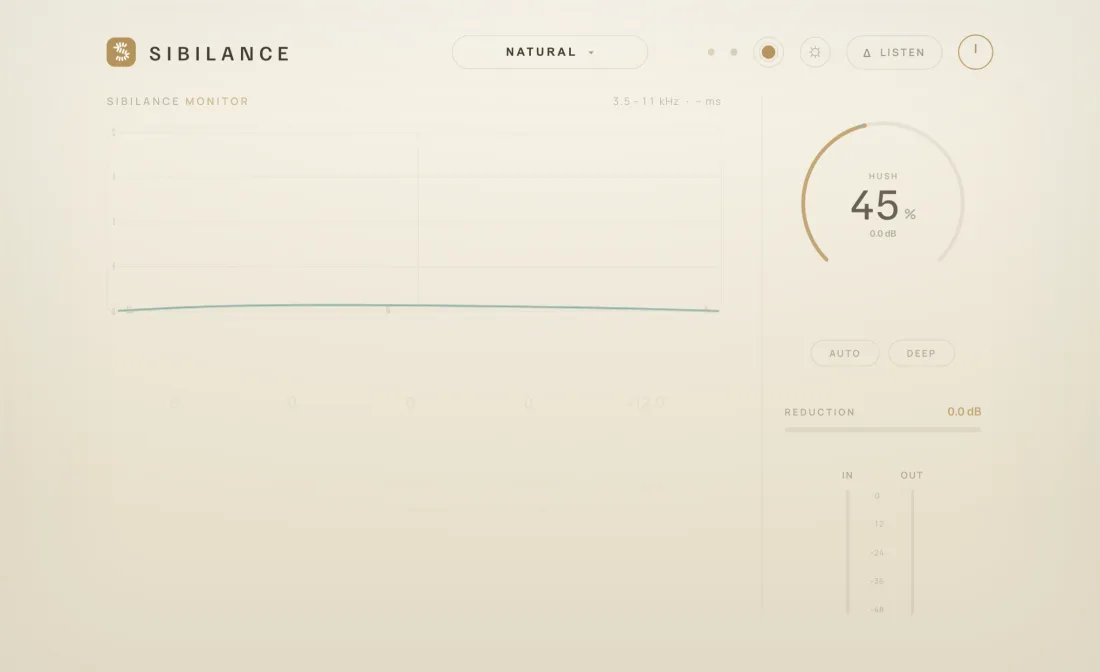
Champagne
Warm gold promoted to primary over ivory. A richer, luxe cousin of teal.
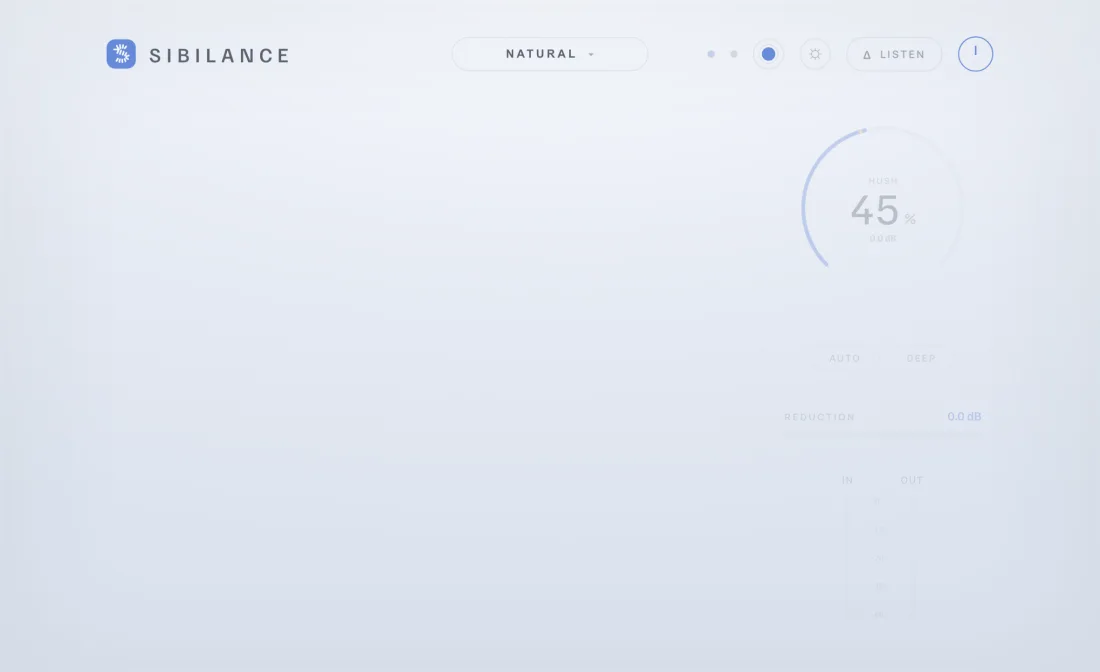
Cobalt
Deep digital blue. Crisp and high-contrast, a precise, technical feel.
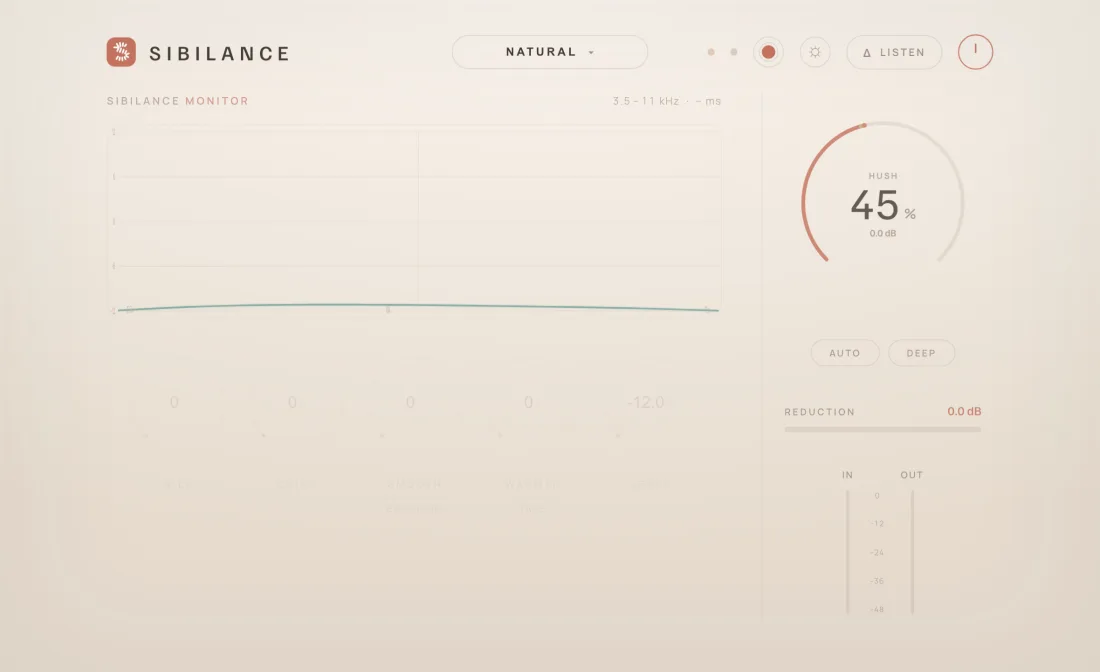
Rosewood
Coral-rose over warm clay. The most characterful, furthest from teal.
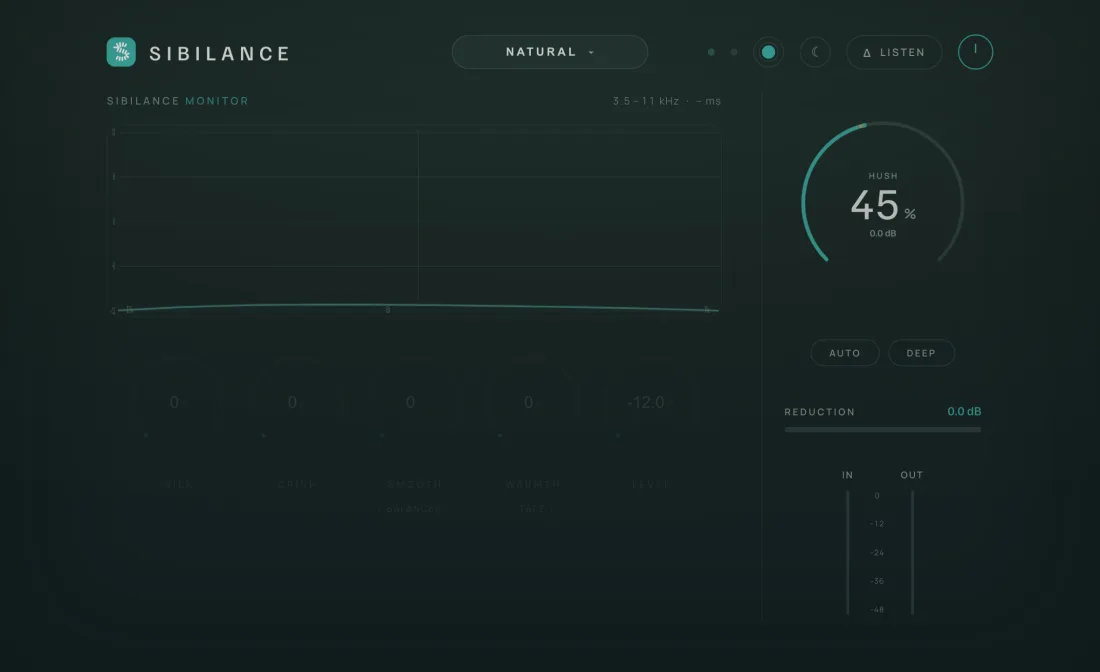
Studio Teal
DefaultThe default. Cool teal over warm ivory, the look you already have.
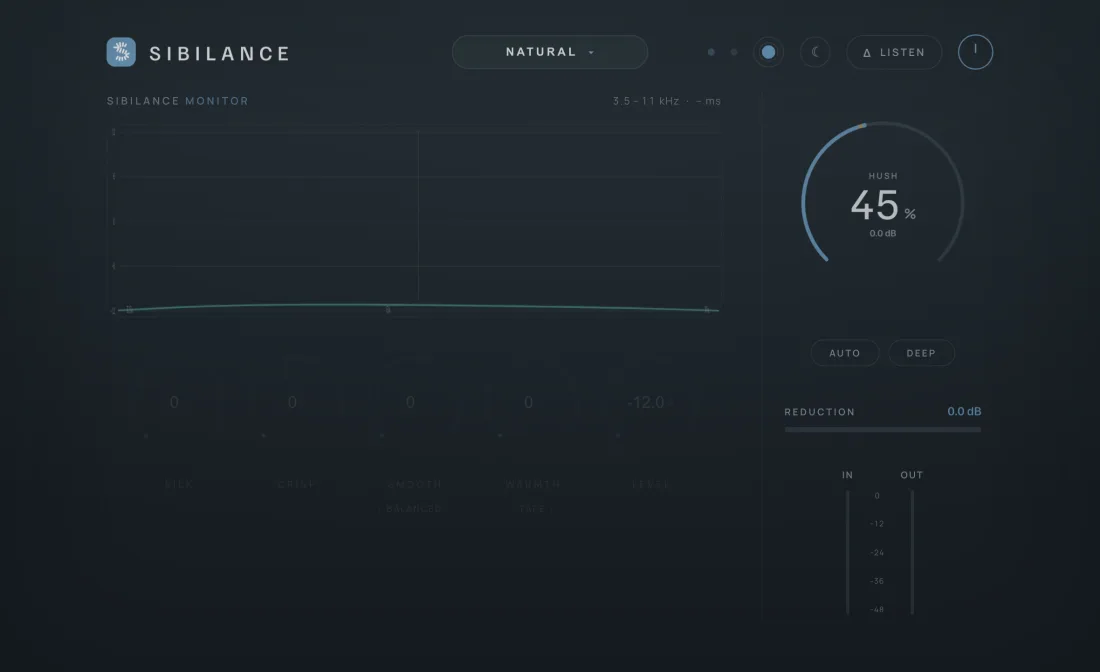
Graphite
Neutral steel. A blue-grey accent over cool grounds, the understated pro-tool look.
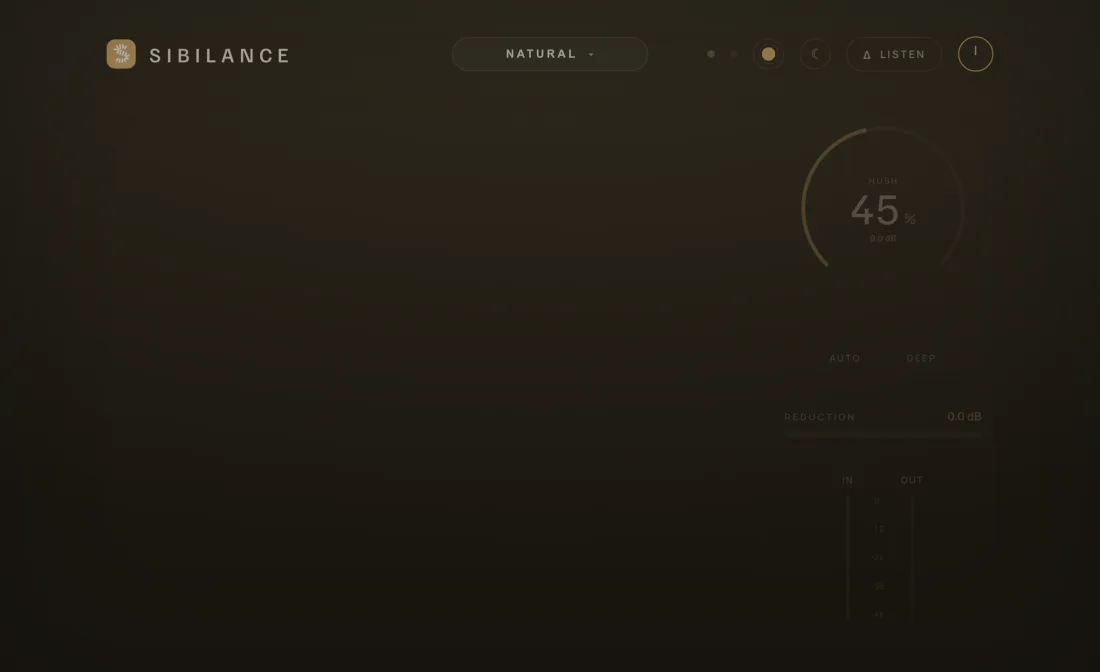
Champagne
Warm gold promoted to primary over ivory. A richer, luxe cousin of teal.
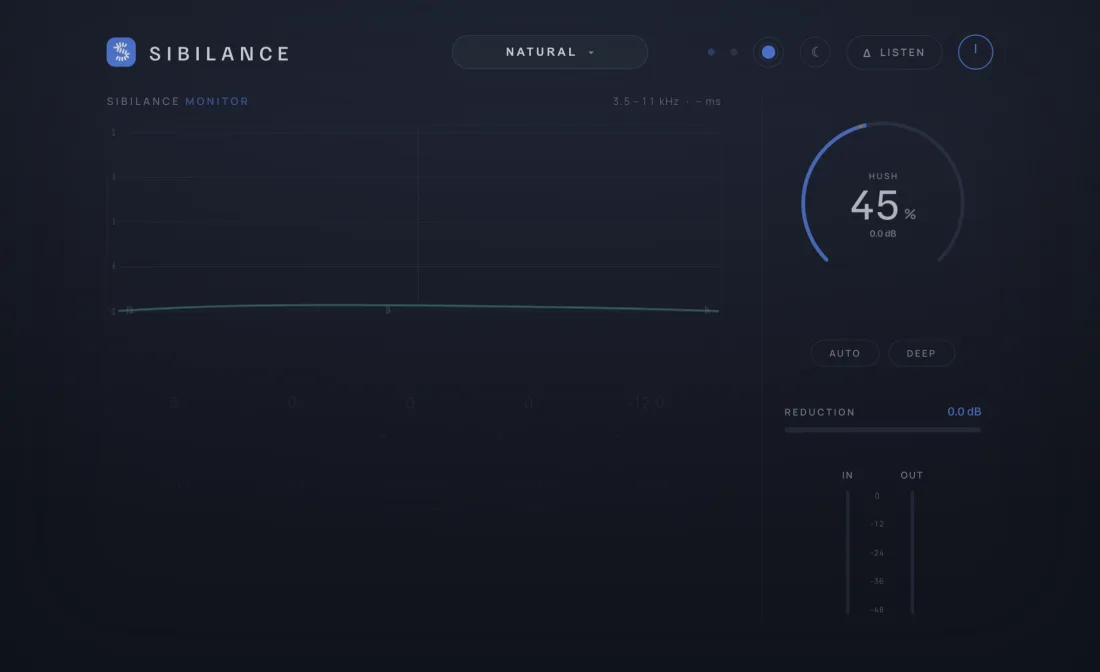
Cobalt
Deep digital blue. Crisp and high-contrast, a precise, technical feel.
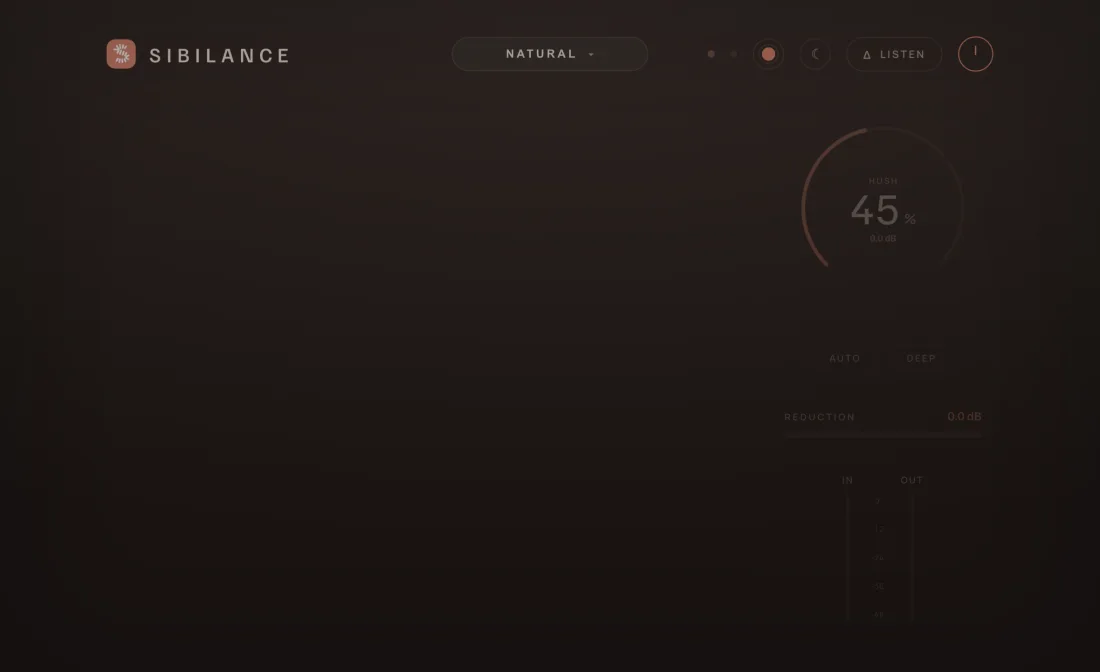
Rosewood
Coral-rose over warm clay. The most characterful, furthest from teal.
No asterisks
We lead where a measurement can settle it, and say so where it cannot.
Head-to-head
Sibilance vs FabFilter Pro-DS.
A fair, itemised read against the reference de-esser. We lead where measurement can settle it, we match on high-end preservation, and where we differ we say why.
We lead on detection intelligence, split-band granularity, provable transparency, and feature breadth; we match on high-end preservation. Pro-DS's longer look-ahead is a marginal gain we do not need, since 5 ms already catches the onsets. Linear-phase is a tradeoff that adds latency and pre-ringing, so we deliberately stay minimum-phase: low-latency and transient-honest. See the full comparison →
Specifications
The build.
- Formats
- VST3 · Audio Unit · CLAP · Standalone.
- DAWs
- Logic · Ableton Live · Pro Tools · FL Studio · Cubase · Reaper, and any VST3 / AU / CLAP host.
- Platforms
- macOS Apple Silicon & Intel · Windows.
- Sample rates
- 44.1 / 48 / 88.2 / 96 / 192 kHz. De-ess depth is invariant across rate — a 0.18 dB spread, measured the way a DAW presents audio (one source, every rate).
- CPU
- ~2.5% of one core, full chain at 48 k. 0 audio-thread allocations.
- Latency
- 5.1 ms Studio / ~1 ms Live, host-compensated.
- Stack
- JUCE 8 · C++20 · WebView UI over a host-independent DSP core.
- Licence
- Perpetual · free tier licensed for commercial use · Pro $79 · 3 machines.
Pricing
Start free. Upgrade when it earns the slot.
Open gives you the core de-esser for commercial work. Pro adds the finishing controls, routing, presets, and workflow features for sessions where Sibilance becomes part of the chain.
- +Core de-essing engine
- +Hush, Auto and Level
- +Δ Listen and Auto Gain
- +Licensed for commercial sessions
- +Everything in Open
- +Silk, Crisp, Smooth and Warmth
- +Mid / Side and stereo modes
- +De-Pop, Breath and De-Lisp
- +External sidechain, A/B, all 21 presets
- +Sibilance Pro
- +Thunder Clarity for bad rooms
- +Every future point release
Seven days of the full Pro instrument, no card. We email a trial key; activate it in the plugin and use every Pro feature in a real session. When it ends, Sibilance reverts to the free Open tier and your settings stay put.
Questions
The practical stuff.
Formats, licensing, the trial, and how to be sure before you pay.
Which DAWs and formats does it run in?
VST3, Audio Unit, CLAP and Standalone, on macOS (Apple Silicon and Intel) and Windows. That covers Logic, Ableton Live, Pro Tools, FL Studio, Cubase, Reaper and any other VST3, AU or CLAP host.
Is the free tier really licensed for commercial work?
Yes. Sibilance Open is the full single-authority de-esser, licensed for commercial use on unlimited machines. It is not a time-limited demo with the good parts switched off.
How does the 7-day free trial work?
Enter your email and we send a trial key. Every Pro feature unlocks for seven days, no card required. When it ends, Sibilance reverts to the free Open tier and your settings stay put.
How many machines does a Pro licence cover?
Three machines per licence, perpetual. You can activate on a new machine any time from your account.
Do I own it, or is it a subscription?
You own it. Every licence is a one-time perpetual purchase, and it includes future point releases.
Can I be sure before I pay?
Yes. The free tier is a real, commercially licensed de-esser, and the 7-day Pro trial lets you run the full instrument on your own sessions before deciding. If a purchase still isn't right, email us and we'll sort it out.
Is the macOS installer signed and notarised?
Yes. It is Developer ID signed and notarised by Apple, so it installs without Gatekeeper warnings.